Vegan Kuala Lumpur: Where Locals Actually Eat
Eating vegan in Kuala Lumpur is easier than most visitors expect. Between Indian vegetarian restaurants, Chinese Buddhist eateries, and a growing plant-based scene, KL has options.
Vegan Food Guide to Kuala Lumpur (2026)
You ordered a vegetable dish at a Malay hawker stall. It looked safe. No meat, no cheese, no egg. You took a bite and it tasted like the ocean. That is shrimp paste. It goes into almost every Malay vegetable dish, and it is not vegan.
This happens to vegan visitors every day in Kuala Lumpur. The city is full of plants, but almost nothing is seasoned the way you expect. The good news is that KL also has one of the most reliable vegan food systems in Southeast Asia: Buddhist vegetarian kitchens. Once you know how to find them, you will eat better than you do at home.
The Buddhist Vegetarian Solution
Chinese Buddhist vegetarianism is stricter than most Western definitions of veganism. It excludes all animal products: meat, seafood, eggs, dairy, and honey. It also excludes the five pungent roots: onion, garlic, leeks, chives, and spring onion. The kitchen is built around Buddhist precepts. This means a 素食 (sù shí) stall is not just vegan by accident. It is vegan by design.
The sign to look for is 素食. You will see it on yellow or green banners outside stalls, painted on shopfront awnings, and displayed in Chinese characters inside food courts. Once you start noticing it, you will see it everywhere: in Chinatown, in the older neighbourhoods of KL, in shopping mall food courts, and in temple canteens.
A 素食 stall does not use belacan (shrimp paste), oyster sauce, eggs, or dairy. The cooking oil is vegetable-based. The sauces are made from mushrooms and soy. You can eat anything on the menu without asking questions.
Brickfields: The Vegan Neighbourhood
Brickfields is KL's Little India and the most reliable part of the city for vegan eating that does not require explaining yourself.
The banana leaf rice stalls here serve vegetable curries that are naturally vegan. Rice is served on a banana leaf with three or four vegetable curries ladled around it. The curries use coconut milk, not dairy. Tell the server "no egg, no ghee" and they will serve you accordingly.
Thosai and idli are fermented rice and lentil cakes. Thosai is crispy and large, like a savoury crepe. Idli is soft and steamed, like a savoury sponge. Both are served with sambar (lentil soup) and coconut chutney. They are naturally vegan.
Pongal is a savoury rice and lentil porridge seasoned with black pepper, cumin, and curry leaves. It is a breakfast staple at South Indian stalls and is almost always vegan.
Veg biryani at Indian-Muslim stalls can be a gamble. Some use ghee, some use vegetable oil. Ask the vendor. The phrase is "Tak pakai ghee?" (No ghee?). Many will tell you honestly.
Vishal Food in Brickfields has a large menu with labelled vegetarian and vegan options. It is a good starting point for anyone new to KL's South Indian food scene.
Temple Canteens: The Best Meal You Will Have for Under RM 5
Buddhist temples in KL run canteens that serve vegetarian food to the public at cost price. The food follows Buddhist precepts strictly. No animal products. No pungent roots. Every dish is vegan.
The Dharma Realm Guan Yin Sagely Monastery on Jalan Ampang has a canteen behind the main prayer hall. Twenty or more dishes are laid out buffet-style every morning. The selection changes daily based on what is fresh at the market. A plate with rice and four or five curries costs around RM 5. The cooks are volunteers. The food is made with the kind of attention you only get when cooking is done as a form of service.
Kun Yam Thong Temple, also on Jalan Ampang, runs a smaller canteen with similar standards. The tables fill up fast during lunch. Regulars bring their own containers.
These canteens are not advertised. There is no website, no Instagram account, no sign on the main road. You have to know they exist to find them.
The Dishes to Order and the Dishes to Skip
Safe to Order at 素食 Stalls
Anything on the menu. Seriously. You do not need to ask questions at a Buddhist vegetarian stall. The whole kitchen is set up for you.
Mock meat dishes deserve special attention. 素食 stalls serve soy-based and mushroom-based versions of chicken, duck, and fish. They look and taste remarkably different from the real thing. The "duck" is made from yuba (bean curd skin), the "fish" from konjac, and the "chicken" from soy protein. These are not modern inventions. Chinese Buddhist chefs have been making mock meat for over a thousand years as a way to preserve culinary traditions while following vegetarian precepts.
Tricky at Malay and Chinese Mixed Stalls
Kangkung belacan is water spinach stir-fried in shrimp paste. Even if you order "no belacan", the sambal at the stall is made with belacan as a base. Skip this at a mixed stall.
Nasi lemak is coconut rice. The rice is vegan. The sambal almost certainly contains belacan. The fried chicken is not vegan. The anchovies are dried fish. A vegan nasi lemak exists, but only at 素食 stalls.
Char kway teow is flat rice noodles. The traditional version is cooked in lard with prawns and eggs. At a 素食 stall, the vegan version replaces lard with vegetable oil and uses mushroom-based seasoning. It has a different kind of smoky flavour.
Laksa is spicy noodle soup. The broth in a standard laksa uses shrimp paste, dried shrimp, or fish stock. Vegetarian laksa exists at 素食 stalls but tastes different because the broth is built on mushroom and soy bases rather than seafood.
Roti canai is made with ghee (clarified butter) at most Mamak stalls. It is rarely vegan. Look for 素食 stalls that make pandan-flavoured roti or chapati instead.
How to Eat in Mixed Settings Without Stress
The safest system is to eat only at 素食 stalls and Indian vegetarian restaurants. These two types of kitchens already work for vegans. You do not need to negotiate or explain.
At Chinese mixed stalls where you see no 素食 sign, assume nothing is vegan. The cooking oil may be lard. The green vegetable sauce is oyster sauce. The broth is chicken or pork. Even a plain plate of rice may have been steamed with chicken stock.
At Malay stalls, assume belacan is in the sambal and in any stir-fried vegetables. The phrase to use is "Tak mahu belacan, tak mahu ikan, tak mahu susu" (No shrimp paste, no fish, no milk). Some vendors can accommodate this. Many cannot.
At Indian mixed stalls, ask about ghee. The phrase is "Tak pakai ghee?" Many South Indian restaurants use vegetable oil by default, but the richer biryani and roti stalls use ghee.
The One Word That Changes Everything
素食. Learn to recognise this character. It is the single most useful word for vegan eating in Malaysia. You can search for it on Google Maps and find stalls that an English search for "vegan" would miss entirely, because many of these places have no English signage at all.
The Buddhist vegetarian tradition has been feeding people in KL for generations. It does not advertise. It does not chase trends. But once you know how to find it, you will eat better here than in most cities that call themselves vegan-friendly.
The Simply Enak food tours in Kuala Lumpur visit several of these stalls and temple canteens. A local guide handles the questions, the ordering, and the navigation, so you can focus on the food that actually works for you.
Love what you just read?
Stay in the loop, add Simply Enak to your Google favorites so you never miss a story.
Ready to taste these flavours yourself?
Join a Simply Enak food tour in Kuala Lumpur or Penang. Small groups, local guides, authentic experiences since 2011.
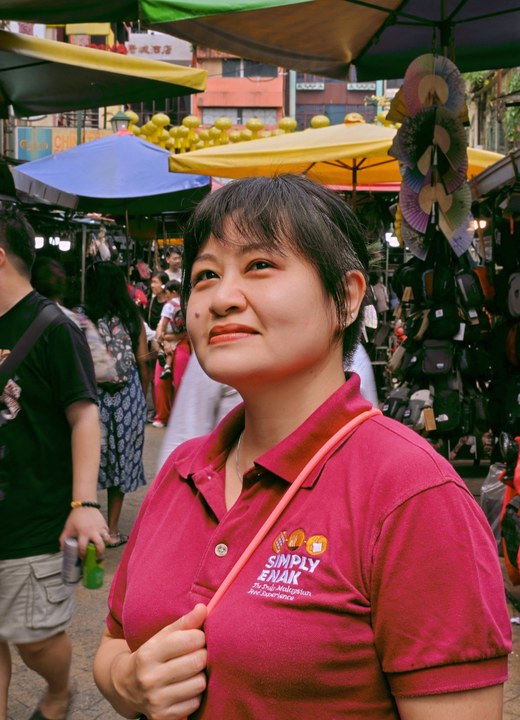
Pauline
Simply Enak Food Experiences
Pauline has been guiding food tours in Malaysia since 2011, sharing hidden gems and family-run stalls with travellers from around the world.
You might also like